
Reading Ahrefs Metrics Like a Pro: Vet Any Outlet Before You Pitch
Domain Rating, organic traffic, referring domains — Ahrefs compresses a website into a handful of numbers. Here is what each metric actually measures, what it hides, and how to use the set to vet media outlets and link prospects before you spend a dollar on coverage.
Every PR and link-building decision comes down to one question: is this site worth it? Ahrefs answers with numbers — if you know what they count. This guide decodes the seven metrics that matter for media research, where each can mislead you, and the vetting routine we run before an outlet makes a campaign list.
Why Ahrefs became the shortcut for site quality
Ahrefs runs one of the largest backlink indexes on the web and its search-traffic models, refreshed constantly. That scale made its headline scores — Domain Rating and URL Rating — the industry’s shorthand: flawed, gameable at the margins, but broadly correlated with what a link is worth. With traffic and keyword data, they separate living publications from metric-inflated shells faster than manual review.
The seven Ahrefs metrics worth your time
Plenty of numbers live in an Ahrefs report; for outlet research, these seven do the real work:
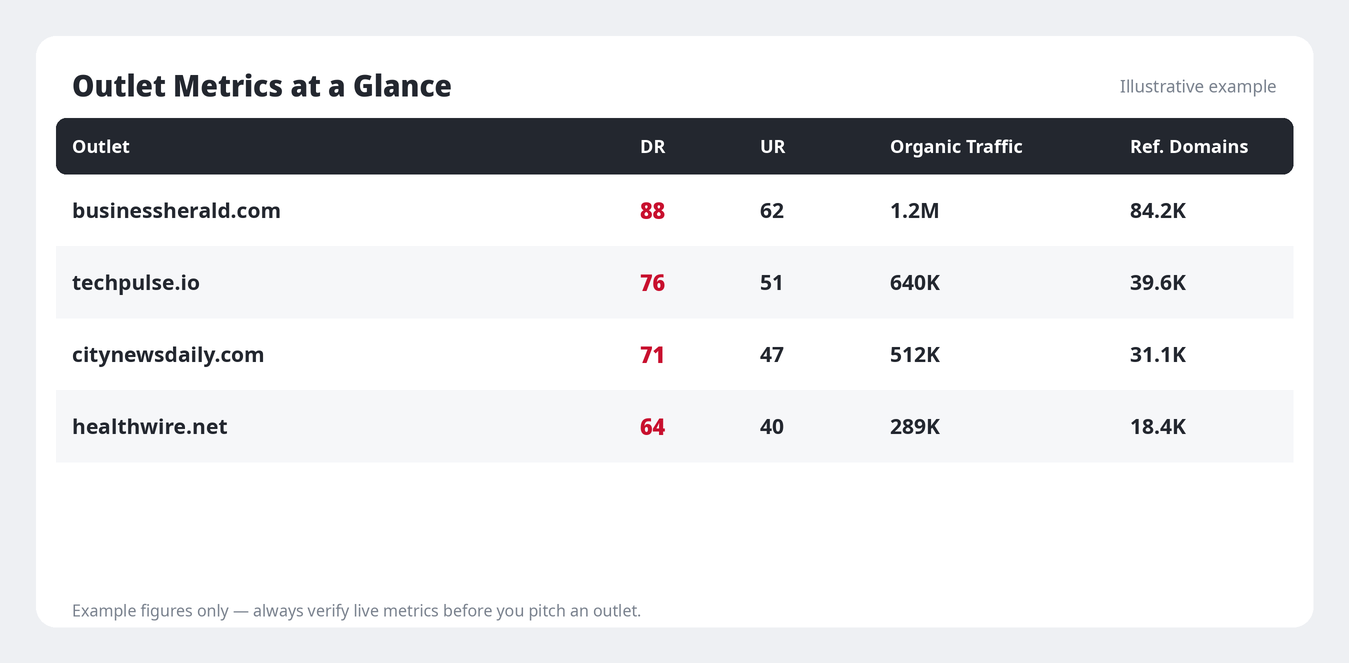
- Domain Rating (DR) — a 0–100 logarithmic score of overall backlink strength: DR 20 to 30 is far easier than 70 to 80.
- URL Rating (UR) — the same at page level. A DR 60 domain can host a UR 2 page; the page you appear on matters as much as the masthead.
- Referring domains — unique sites linking in. Steady growth is healthy; a vertical spike means a link scheme, not fame.
- Backlinks — the raw link count, useful mainly against referring domains: healthy profiles have many domains contributing modest links each.
- Organic traffic (estimated) — Ahrefs’ model of monthly search visits: a trend and floor for reality, not an exact figure.
- Organic keywords — queries the site ranks for in the top 100, and in which positions. Broad coverage signals genuine editorial reach.
- Traffic value — what that traffic would cost to buy as ads: the fastest check that rankings target queries with commercial life.
Where to find the metrics and filter by them
Site Explorer gives the panel for any domain in one search. Filtering at scale is the workflow upgrade: batch analysis lets you paste dozens of candidates, sort by DR, traffic and referring domains in one table, and turn a longlist of 200 outlets into a shortlist of 30. Sort by traffic trend next — a site whose visits fell off a cliff six months ago tells you something DR alone will not.
What these numbers give a PR campaign
The metrics turn media selection from gut feel into a defensible process. Promise clients a floor — placements averaging DR 50+ — and prove it in the report. Price effort correctly: outreach hours go to outlets whose links move rankings. Catch the fakes: expired-domain networks wear impressive DR badges while traffic and keyword charts sit at zero. Two minutes per domain, and pretenders filter themselves out.
We apply the same standard to distribution lists: every outlet in a PressFudge package earns its place with real metrics and audiences, and the report lists each placement’s live link so clients can verify quality.
A five-minute vetting routine
When a new outlet or prospect lands on your desk, run this sequence first:
- Check DR and referring domains — is authority real and broad-based?
- Open the traffic chart — is traffic stable or growing over 12 months?
- Scan top pages — does it publish what it claims?
- Read anchor profile — natural brand/topic anchors, or keyword-stuffed schemes?
- Recent backlink growth — earned steadily, or bought in a lump?
Five checks, five minutes, and most bad placements eliminate themselves. Domains passing all five are worth your outreach hours and clients’ budgets — quality control separates a media list from a link list.
Reading the data without fooling yourself
Three habits keep metrics honest. First, never judge by DR alone — pair it with traffic and referring-domain trend every time. Second, check anchors and top pages: a news site whose most-linked content is casino reviews is not a news site for your purposes. Third, recheck before each campaign, not yearly; domains get sold, repurposed and penalised, and last spring’s vetting expires.
Frequently asked questions
What is a good Domain Rating for a media outlet?
DR 40+ is a workable floor for meaningful SEO value, and DR 60+ is strong. Context matters: a DR 35 regional newspaper with real local traffic can beat a DR 70 content farm for a local story.
Can Domain Rating be faked?
Yes — inflated with manipulative links, which is why you cross-check organic traffic and keyword rankings. Inflated domains show high DR with near-zero traffic: the mismatch is the tell.
How often does Ahrefs update its metrics?
Backlink data refreshes continuously, and DR recalculates as profiles change. For campaign decisions, pull fresh numbers the week you build the list.
Ready to get your story published?
PressFudge distributes your press release to hundreds of real news outlets — with a publication guarantee and a live-link report for every campaign.
See pricing & publish
The PressFudge team distributes press releases for startups, brands and agencies - and writes about what actually works.